Northland (North Island)
Northland is the birthplace of viticulture in New Zealand:
In 1819, missionary Samuel Marsden planted the first grapevines in Kerikeri, where the vinery has a long, albeit intermittent, winemaking history.
Commercial winemaking was dormant until the late 20th century, when small vineyards began to revive wine potential of the region.
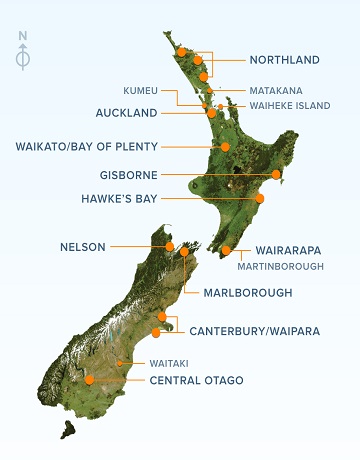
Statistics, maps and images credit: New Zealand Wine
Grape Varieties
Northland is not dominated by a single grape variety like Marlborough's Sauvignon Blanc. Instead, it produces a diverse range of wines, with an emphasis on full-bodied, ripe styles.
Because of the region's small-scale, boutique nature, many wines are produced in limited quantities, with an emphasis on quality and uniqueness.
The warmer conditions mean that Northland wines tend to be riper, rounder, and more fruit-forward than those from southern regions:
| Grape | Description | Ha |
|---|---|---|
| Chardonnay | Often tropical and full-bodied due to the heat. | 20 |
| Syrah | Rich, spicy, and peppery. | 14 |
| Pinot Gris | More off-try Alsace style than Italian Pinot Grigio style. | 11 |
| Merlot | Ripe and fruity. Used in Bordeaux-style blends. | 6.0 |
| Pinotage | 3.7 | |
| Cabernet Franc | Merlot and Cabernet combinations are often soft and generous. | 3.6 |
| Viognier | Shines in the climate, which results in ripe, full-bodied wines. | 3.5 |
| Sauvignon Blanc | More tropical and full than in Marlborough. | 2.0 |
| Chambourcin | A hybrid grape that thrives in humid conditions. | 3.0 |
| Tannat | Full, deep inky ruby-red wines with red berries, plums and spices. | 1.6 |
| Gewürztraminer | The subtropical climate offers unique possibilities, but production is small. | 1.4 |
Outlook
Northland continues to develop its identity as a boutique region focused on warm-climate varietals, small-lot wines, and sustainable viticulture.
While not a volume producer, it plays a key role in New Zealand's wine heritage and offers a unique flavor profile that complements the country’s broader wine scene.
Wine Regions
Northland is the northernmost wine region in New Zealand, extending from the tip of the North Island down to Whangārei, and west and east to both coasts.
Vineyards are generally clustered in the coastal areas around Whangarei, the Bay of Islands, and Kerikeri, taking advantage of both the flatter coastal land and the tempering sea breezes.
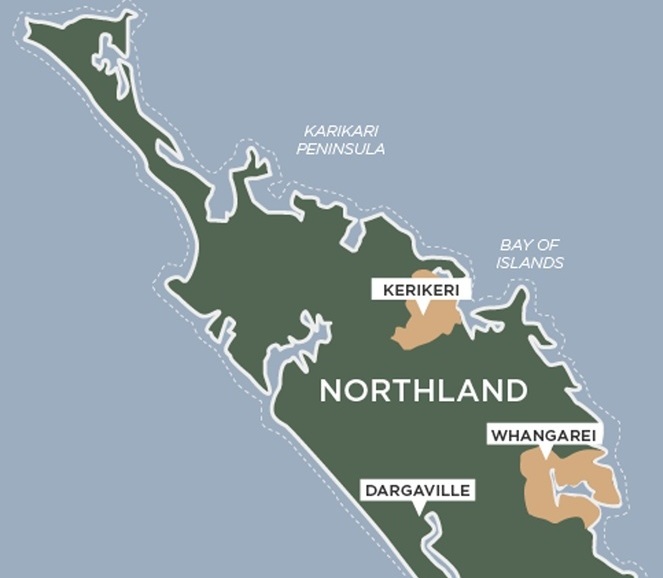
Kerikeri
- The most developed wine region in Northland.
- Home to pioneering estates (Marsden Estate and Ake Ake).
- Offers tourism-friendly cellar doors, often paired with restaurants and accommodation.
Whangārei and Mangawhai
- Smaller but growing wine presence.
- Boutique producers focused on sustainable and organic practices.
Climate
Northland has a subtropical maritime (humid) climate influenced by surrounding oceans:
- Latitude: Approximately 35°S
- The warmest wine region in New Zealand
- Long, warm growing seasons
- High humidity and moderate to high rainfall
- Plenty of sunshine (less than Marlborough)
- Early budburst and harvest
- Grapes often picked in February (earliest in NZ)
These conditions allow for the ripening of both early and late-ripening grape varieties, with less risk of frost but a higher threat of mildew due to humidity.
Soil
Volcanic, clay-based, and free-draining soils, varying by sub-region.
Challenges
- High humidity = greater disease pressure (e.g., downy mildew)
- Risk of cyclonic weather disrupting vintages
- Limited vineyard land due to development and geography
Opportunities
- Early harvest allows for consistent ripeness year after year
- Growing popularity of boutique wines and wine tourism
- Potential for organic and biodynamic winemaking due to small-scale viticulture