Hawke's Bay (North Island)
Located on the eastern coast of the North Island, Hawke's Bay is New Zealand's oldest and second largest wine region.
The wine production began in the 1850s when a Marist priests from Lyon in France, planted the first vines. Today there are over 40 wineries in the region.
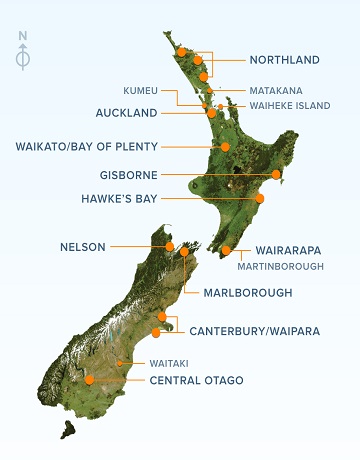
Statistics, maps and images credit: New Zealand Wine
Key Grapes
Hawke's Bay is known for its Bordeaux style red wines, and the region also produces exceptional Chardonnay, as well as some excellent Sauvignon Blanc.
| Grape | Hectares |
|---|---|
| Sauvignon Blanc | 1,035 |
| Chardonnay | 1,034 |
| Merlot | 844 |
| Pinot Gris | 657 |
| Syrah | 317 |
| Pinot Noir | 221 |
| Cabernet Sauvignon | 174 |
| OTHERS (30+ varieties) | 292 |
Red Wines
- Rich, structured, and age-worthy.
- Bordeaux blends (Merlot-Cabernet)
A hallmark of the region. - Syrah
Stands out with peppery spice, floral notes, and vibrant fruit.
White Wines
- Chardonnay
Ranges from lean and mineral to creamy and oaked. Often considered New Zealand’s best. - Sauvignon Blanc
More subdued than Marlborough's. Often blended or oaked for complexity. - Pinot Gris, Viognier, Gewürztraminer, Albariño
Expressive, with good natural acidity and perfume.
Red Grapes (40–45% of production)
- Merlot
Soft and plummy. Often blended. - Cabernet Sauvignon
Deep and structured. Needs warmer sites - Syrah
Elegant and spicy, Rhone-style wines. A regional standout. - Malbec, Cabernet Franc, Tempranillo
Smaller plantings. Often blended
White Grapes (55–60%)
- Chardonnay
Most planted white, with diverse styles from crisp to oaked. - Sauvignon Blanc
More restrained and tropical than Marlborough. - Pinot Gris, Viognier, Gewürztraminer, Albariño
Increasingly planted aromatics.
Future Outlook
- Continued focus on premium red wine production, especially Syrah and Cabernet/Merlot blends.
- Growth of Chardonnay as a world-class contender.
- Rising interest in less common varietals like Albariño, Tempranillo, and Grüner Veltliner.
- Expansion of sub-regional branding to showcase terroir.
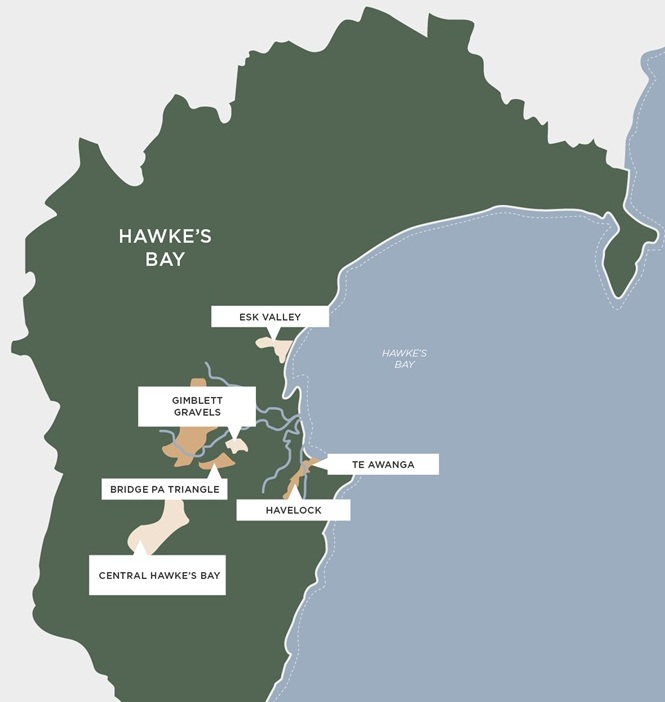
Wine Regions
Gimblett Gravels
- Most famous sub-region, known for Bordeaux blends and Syrah.
- Sits on an ancient, gravelly riverbed with excellent drainage and heat retention.
- Home to elite producers like Trinity Hill, Craggy Range, and Villa Maria.
Bridge Pa Triangle
- Slightly cooler and more fertile than Gimblett Gravels.
- Produces expressive Syrah, Merlot blends, and aromatic whites.
Te Awanga
- Coastal influence and cooler microclimate.
- Ideal for Chardonnay, Pinot Gris, and Sauvignon Blanc.
Havelock Hills / Dartmoor Valley / Esk Valley
- Hill sites with clay and limestone-rich soils.
- Suited to structured reds and elegant whites.
- Many boutique wineries and single-vineyard expressions.
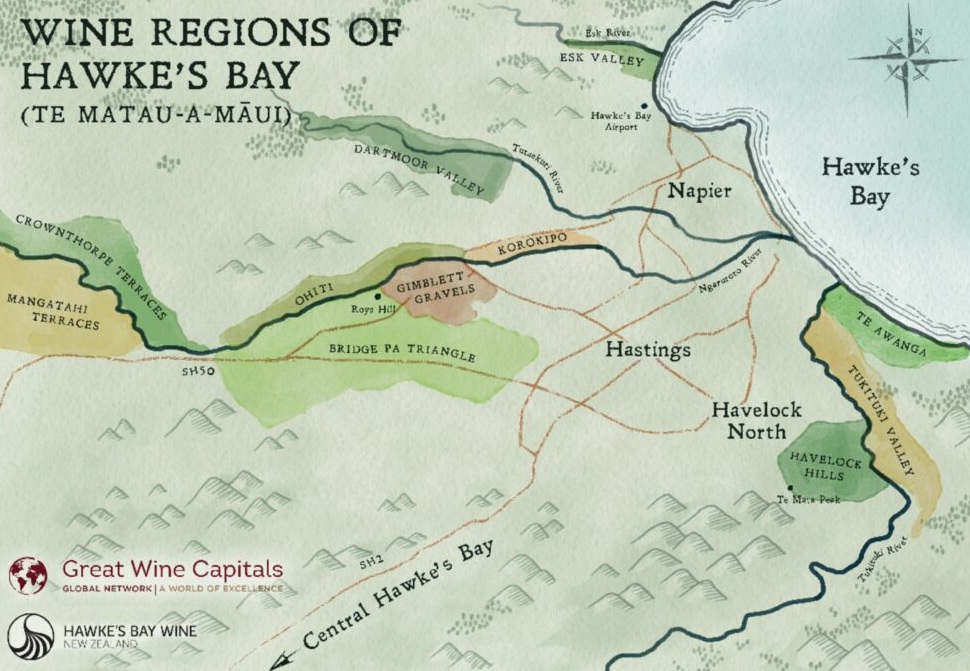
Climate
Hawke's Bay has a warm maritime climate with long sunshine hours (second only to Nelson).
The region has hot and dry summers, with cool nights, and low to moderate rainfall during the growing season.
Excellent diurnal range (warm days, cool nights) is ideal for flavor development and acidity retention.
Soil
The soil is extremely diverse with over 25 different soil types, including:
- Free-draining gravel (Gimblett Gravels)
- Sandy loams
- Clay hillsides
- Limestone-rich soils in inland areas
The Gimblett Gravels sub-region is particularly well-known for its unique stony soils, which produce intensely flavored red wines.