Spanish Wine Laws DOC
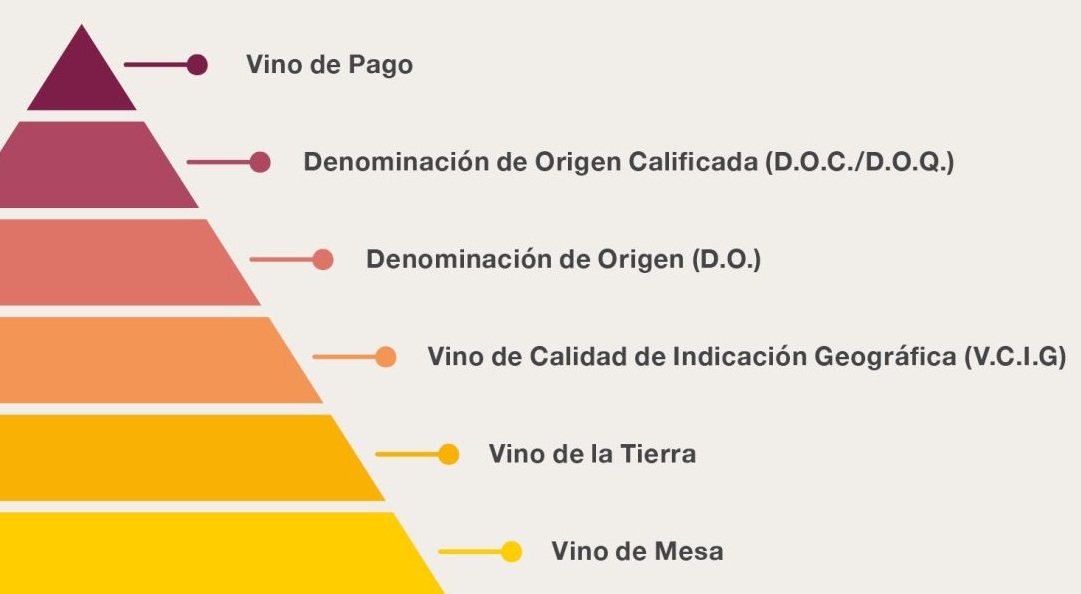
Spain got a national framework for wine appellations in 1932.
Today, Spanish wine classifications operate within the EU system.
The three europeean categories are:
- DOP - Wines with a protected designation of origin
- IGP - Wines with a protected geographical indication
- Wine without DOP or IGP - Wines without a protected geographical indication
DOP Wines
DOP - Denominación de Origen Protegida
In English: PDO - Protected Designation of Origin.
The wine's qualities or characteristics must be essentially or exclusively linked to its geographical environment.
All grapes must come from the defined production area, and winemaking must take place within the geographical area.
Each DOP has a pliego de condiciones (production specification):
- The protected name and geographical area
- The permitted grape varieties and wine types
- The maximum yields
- The vineyard and winemaking requirements
- The wine's analytical and sensory characteristics
- The link between the wine and its origin
- Specific ageing and labelling conditions, where applicable
Within DOP, Spain uses its own traditional terms:
- VP - Vino de Pago
- DOCa - Denominación de Origen Calificada
- DOQ - Denominació d'Origen Qualificada
- DO - Denominación de Origen
- VC - Vino de Calidad con Indicación Geográfica
Within IGP, Spain has only one term:
- VT - Vino de la Terra
Vino de Pago
VP - Vino de Pago
A pago is a defined rural site with distinctive soil and microclimate.
Vino de Pago is a separate route to DOP recognition for wines from such a site.
- All grapes must come from the recognized pago
- Its wines must be produced and stored separately from other wines
- Production must follow a comprehensive quality-control system
- Specific production and bottling requirements apply
It should be understood as a site-specific DOP category rather than simply a promotion above DOCa.
DOCa / DOQ Wines
DOCa - Denominación de Origen Calificada
DOQ - Denominació d'Origen Qualificada (Catalan)
In English: Qualified Designation of Origin.
This status adds requirements to those of DO.
- At least 10 years of prior DO status
- Bottling in registered wineries within the defined area
- Systematic analytical and sensory checks by wine lot
- Additional controls over registered wineries and grape sources
Rioja uses DOCa, while Priorat uses the Catalan DOQ.
DOCa / DOQ is within the European DOP category.
DO Wines
DO - Denominación de Origen
DO - Denominació d'Origen (Catalan)
In English: Designation of Origin.
DO identifies established appellations with a recognized reputation and defined production rules.
The rules regulate geographical origin, grape varieties, yields, and wine production.
Each appellation's management body and control arrangements oversee the use of its protected name and compliance with its specification.
DO is within the European DOP category.
VC Wines
VC - Vino de Calidad con Indicación Geográfica
In English: Quality Wine with a Geographical Indication.
Despite the wording, VC belongs to DOP, rather than IGP.
These wines come from a defined area and have characteristics linked to that area and its human factors.
The label uses the wording Vino de Calidad de... followed by the protected geographical name.
VT / IGP Wines
VT - Vino de la Tierra
IGP - Indicación Geográfica Protegida
In English: PGI - Protected Geographical Indication.
The wine must have a quality, reputation, or other characteristic linked to its geographical origin.
At least 85% of the grapes must come from the defined geographical area, and winemaking must take place there.
Each IGP wine has a production specification defining its area, permitted wines, and production requirements.
IGP generally gives producers greater flexibility than DOP.
Wines Without DOP or IGP
Vino de España - Spanish Wine
Vino de Mesa - Table wine (House wine)
Spanish wine without a protected geographical indication can identify Spain as its country of origin.
It does not carry the protected regional identity of a DOP or IGP.
Producers have greater flexibility to blend grapes from different Spanish wine-growing areas.
General wine production and labelling regulations still apply.
The vintage and grape varieties may appear on the label when the relevant control and certification requirements are met.
Aging Terms
Crianza, Reserva, and Gran Reserva
These are regulated ageing terms, rather than geographical classifications.
A wine can therefore be both DOCa Rioja and Reserva.
Requirements depend on the wine type and appellation.
| Term | Minimum Total Ageing | Minimum in Oak Barrels | Minimum in Bottle |
|---|---|---|---|
| Crianza | 24 months | 12 months | None |
| Reserva | 36 months | 12 months | 6 months |
| Gran Reserva | 60 months | 24 months | 24 months |
The barrel and bottle minimums are included within the total ageing period.
White, rosé, and sparkling wines have different requirements.
Sources
- Spanish Ministry of Agriculture: DOP, IGP, and traditional wine terms
- Spanish Ministry of Agriculture: Traditional terms
- BOE: Law 6/2015, including traditional wine terms
- Spanish Ministry of Agriculture: Wine marketing and labelling
- DOCa Rioja: Classification and ageing requirements
- DOQ Priorat: The appellation