French Wine Laws
The French AOC system was established in 1935.
It protects the origin and identity of wines through rules linking them to a defined geographical area.
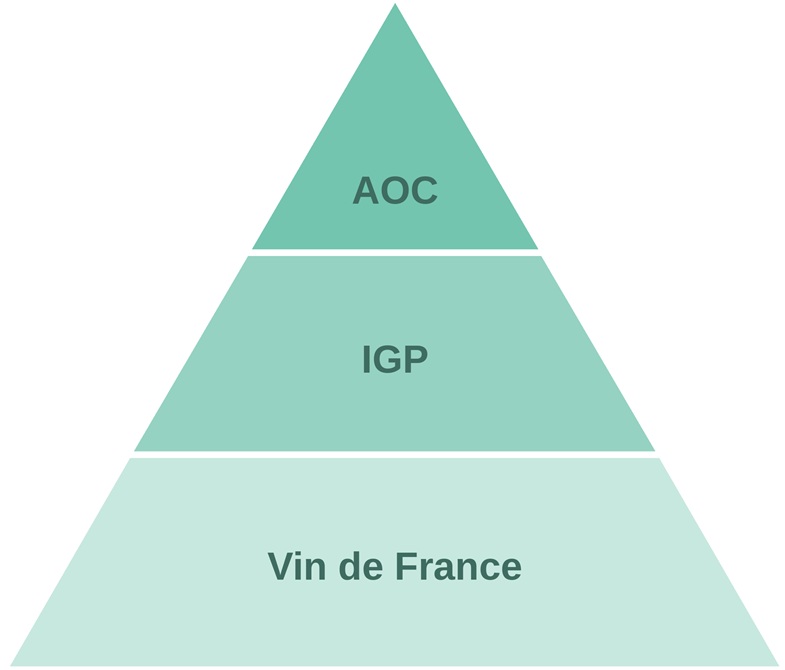
Today, French wines have three main categories:
- AOP / AOC - Wines with a protected designation of origin
- IGP - Wines with a protected geographical indication
- Vin de France - Wines without a protected geographical indication
AOC and AOP belong to the same tier, rather than two separate levels.
The hierarchy describes geographical protection and production requirements, rather than guaranteeing how much you will enjoy a wine.
AOP / AOC Wines
AOP - Appellation d'Origine Protegée
In English: PDO - Protected Designation of Origin
AOC - Appellation d’Origine Contrôlée is the traditional French designation.
AOC provides national recognition before registration as an AOP at European Union level.
French wines registered as AOP can continue to use the traditional AOC wording on their labels.
The wine's qualities or characteristics must be essentially or exclusively linked to its geographical environment, including natural and human factors.
Each appellation has its own production specification, covering matters such as:
- The geographical production area and eligible vineyard parcels
- The permitted grape varieties and blending rules
- Vineyard management, planting density, and pruning
- The maximum yields and minimum grape ripeness
- The permitted winemaking practices
- The wine's analytical and sensory characteristics
- Maturation and release requirements, where applicable
Compliance is checked under an approved control system.
Requirements differ between appellations, so barrel ageing and bottling within the area must be checked in the individual specification.
Premier Cru and Grand Cru
Cru can refer to a vineyard, a wine-growing site, or an estate, depending on the region.
Premier Cru and Grand Cru have region-specific meanings within the appellation system.
They do not form additional nationwide categories above AOP.
Burgundy
Burgundy's hierarchy is commonly explained in four steps, from broader origins to more precisely defined sites:
- Regional - Appellations covering a region or part of it
- Village - Appellations associated with one or more villages
- Premier Cru - Recognized sites within village appellations
- Grand Cru - Appellations for highly specific vineyard sites
Legally, Premier Cru is a designation within a village appellation, rather than a separate AOC tier.
Bordeaux
Bordeaux has several classification systems, including the 1855 classification, which ranks estates.
These classifications operate alongside appellations and should be read according to their own rules.
IGP Wines
IGP - Indication Géographique Protegée
In English: PGI - Protected Geographical Indication
IGP wines have a quality, reputation, or other characteristic linked to their geographical origin.
Each IGP has a production specification called a cahier des charges.
The specification defines requirements such as:
- The protected name and geographical area
- The permitted grape varieties
- The types and characteristics of wine
- The maximum yields
- The production conditions and practices
- The link between the wine and its origin
IGP generally allows greater flexibility in grape varieties and winemaking than AOP.
The traditional French term Vin de Pays may still appear on qualifying wine labels.
Vin de France
Vin de France - Wine of France
Vin de France is the broadest category for French wine.
It belongs to the category VSIG - Vin Sans Indication Géographique (wine without a geographical indication).
The designation identifies France as the country of origin but does not identify a protected wine region.
Producers can blend grapes from different parts of France, subject to general wine regulations.
The grape variety and vintage can appear on the label when the applicable certification and labelling requirements are met.
This gives producers greater flexibility than an appellation's production rules.
Vin de France includes both everyday wines and ambitious wines made outside appellation specifications.
French and European Terms
| French | English | Meaning |
|---|---|---|
| AOP | PDO | Protected designation of origin |
| IGP | PGI | Protected geographical indication |
AOP and IGP also protect food products, including qualifying cheeses and other agricultural products.
The EU AOP and IGP logos are optional on wine labels.
Older Wine Terms
Vin de Table is the older table-wine category associated with today's wines without a geographical indication.
VDQS (Vin Délimité de Qualité Supérieure) was a former category between Vin de Pays and AOC.
VDQS was abolished at the end of 2011 and is no longer part of the current hierarchy.