Sand
Sand is found near large bodies of water, like in coastal regions and river valleys.
It is a granular material of mineral particles bigger than silt.
Sand can come from any type of rock that has been broken down into small grains.

Spiaggia Grande vineyard in Sardinia (Italy) on a sandy soil close to the sea.
Sandy soils warm up quickly in the spring, aiding early vine growth. They have good drainage, but can dry out quickly and struggle with water retention. In regions with little rain, sandy soils may require more irrigation.
Sandy soils are one of the few soils that Phylloxera does not thrive in.
Grapes:
- Sauvignon Blanc
- Nebbiolo
- Sangiovese
- Zinfandel
- Malbec
- Verdejo
- Vermentino
- Vernaccia
- Torrontes
Best known Regions:
- Graves (Bordeaux Right Bank, France)
- Médoc (Bordeaux Right Bank, France)
- Cannubi in Barolo (Italy)
- Serralunga d'Alba (Italy)
- Sonoma Coast (USA)
- Lodi in California (USA)
- Barossa Valley (Australia)
- Swartland (South Africa)
Gravel
Gravel soil is pebble soil that has good drainage but poor fertility.
Plants in gravel soil must penetrate deeply to find nutrients in the subsoil.
Wine from clay subsoil have less acidity than those from limestone subsoil.
Best known Regions:
- Graves and Sauternes in Bordeaux (France)
- Côtes du Rhône South (France)

Gravel Soil of the Bordeaux wine estate Chateau d'Yquem
In Loire, this soil appears in the form of alluvia (sediment deposited by waterways) on the banks of the Loire, the Cher and the Arnon, and is particularly common in the Quincy wine region.
Residual Soil
Residual Soil is the result of weathering and decomposition of rocks.
Colluvial Soil
Colluvial Soil (Colluvium / Colluvial Material) is a soil of loose sediments that have been deposited in hillslopes by either rainwash, floodwash, slow continuous downslope creep, or a combination of these.
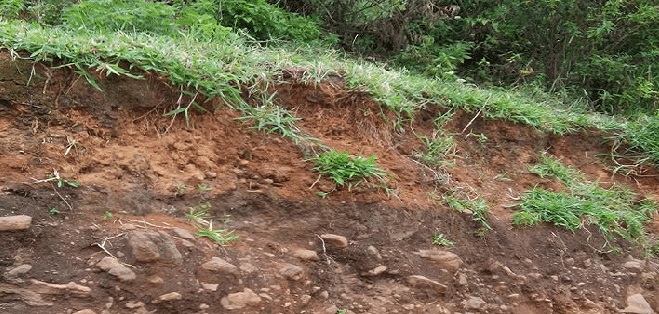
Alluvial vs. Colluvial
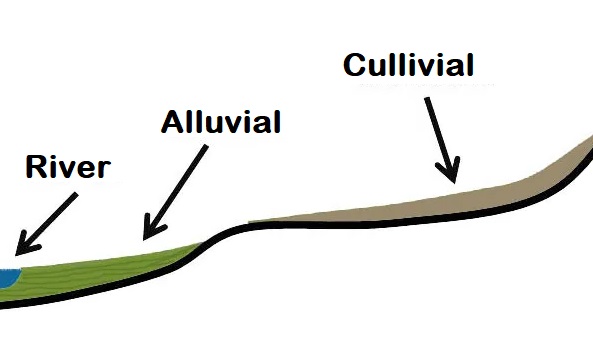
Colluvial Soil (Colluvium / Colluvial Material) is formed by gravity.
Alluvial Soil (Alluvium / Alluvial Deposit) is formed by water.
Alluvial Soil
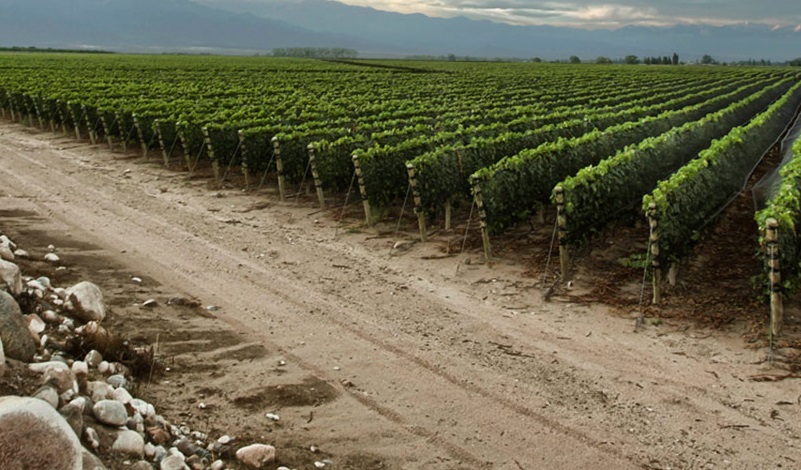
Alluvial Soil (Alluvium / Alluvial Deposit) is loose clay, silt, sand or gravel that has been deposited by running water. You will find it along rivers, in floodplains and deltas, stream terraces, and in areas called alluvial fans.
Alluvial soils are formed by flooding. Because floods periodically deposit new sediments, alluvial soils can have a unique layered look where dark and light colors alternate, along with assorted sizes of gravel particles.
Because a lot of organic material is carried by water, alluvial soils are very fertile. Some vinemakers believe alluvial soils are the best.
Pros: Humus rich. Mineral rich. Very fertile.
Cons: Poor water retention.
Best known Regions:
- Rhine floodplans (Germany)
- Danube River (Austria)
- Ebro River in Rioja (Spain)
- Napa Valley (USA)
- Mendoza (Argentina)
- Aconcagua Valley (Chile)