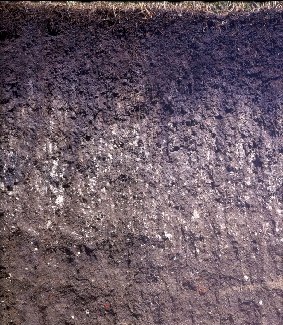
Loam
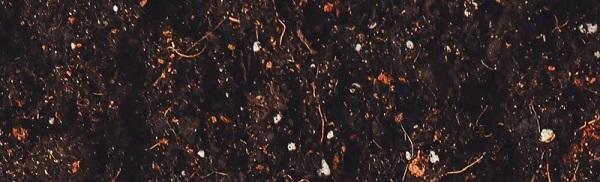
Loam is a combination of Sand, Silt and Clay.
Loam is considered the best soil for almost any type of plants:
- It is granular
- It retains water
- It have good drainage
- It contains organic matter
Loam can be too fertile for vine grapes that need more difficult soil to struggle with.
Pros:
- Good drainage
- Very fertile
- Retains nutrients and water
Cons:
- Too fertile for vineyards
Vineyard Loam
The magic of loam is that sandy loam, clay loam, and silt loam
make up some of the the greatest wine soils in the world.
Sand helps drainage. Clay has nutrients and water-holding capacity.
Silt helps with both heat retention and water holding.
Pinot Noir thrives well with this blend in Napa Valley and Sonoma Valley (USA).<(p>
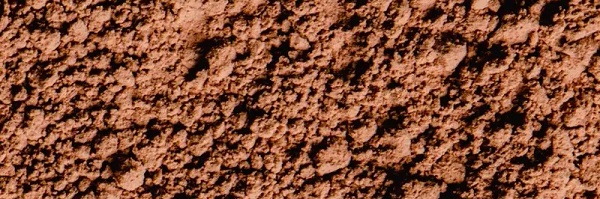
Clay Loam: Higher clay content, retains more moisture
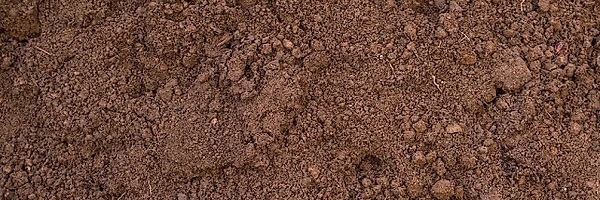
Sandy Loam: Higher sand content, good drainage.
On the picture below, you will see 3 layers of loam:
- Surface is dark brown fine sandy loam
- Subsurface is pale brown fine sandy loam
- Subsoil is red clay loam and sandy clay loam
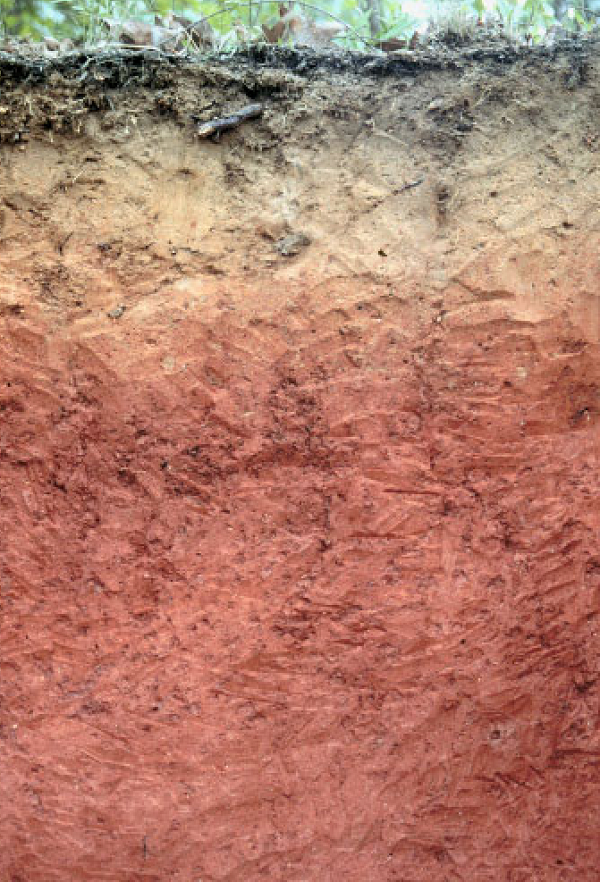
Source: Wikipedia Commons.
Silt
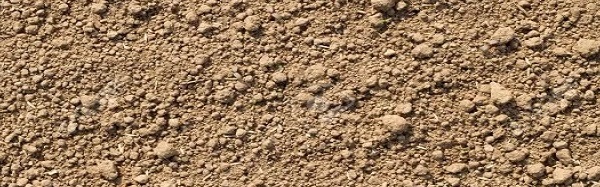
Silt is found in river valleys.
It is a granular material of mineral particles smaller than sand and larger than clay.
Silt is more fertile than sand, hold moisture well, but is prone to compaction (similar to clay),
which can affect drainage and aeration.
With proper management, silty soils can be suitable for vine cultivation.
Silt produces: Smooth wines with low tannins.
Grapes:
- Pinot Noir
- Grüner Veltliner (Austria)
- Pinot Gris (France)
Best known Regions:
- Washington (USA)
- Willamette Valley (Oregon, USA)
Loess
Loess is a sediment of accumulated wind-blown dust of sand and silt
cemented by clay and lime.
It is defined as 20% clay with roughly 40% sand and 40% silt.
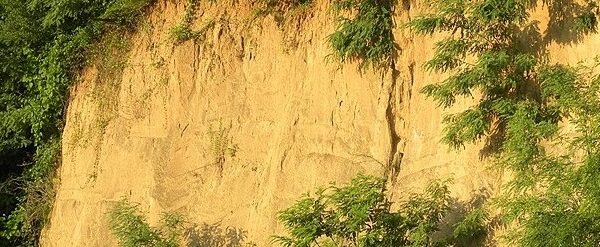
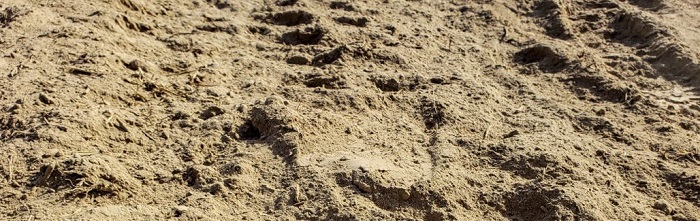
Loess is pronounced luss and means "loose". It is commonly known as "brickearth" in the UK.
Loess is porous and permeable, great for root penetration, and full of nutrients giving
minerality to the vines. It is very fertile and has good water retention and warming properties, but drains poorly.
Best known Regions:
- Nahe, Pfalz, Rheingau and Baden (Germany)
- Wagram (Austria)
- Walla Walla (Washington, USA)
- Hawkes Bay (New Zealand)
Chernozem, or "black earth," is a highly fertile, humus-rich soil found in grasslands
(steppes) such as Ukraine, Russia, the Canadian Prairies, and the Pampas of South America.
While primarily known for grain production, chernozem is used in specific viticultural regions,
particularly in Eastern Europe, producing wines often characterized by high extract and good mineral
structure due to high calcium carbonate levels.
Wine Region Examples
- Bulgaria/Danube Plain
Often features carbonate and leached chernozems, supporting varieties
like Gamza and Vratsa Muscat, producing quality red wines.
- Romania
Cultivated with Calcaric Chernozem, which supports "Fetească Regală" variety.
- Slovakia
Haplic Chernozem in the Danube lowlands is used for vineyard studies.
- Canada (Okanagan Valley)
Orthic Brown and Dark Brown Chernozems are utilized, particularly
for Pinot Noir and Riesling.
- Germany (Rheinhessen)
Sandy loess chernozem is used to produce aromatic white wines
(gooseberry, grapefruit, passion fruit).
Alcohol can be addictive. Always drink in moderation.
© Copyright 2015-2026 W3 Wine School. All Rights Reserved.